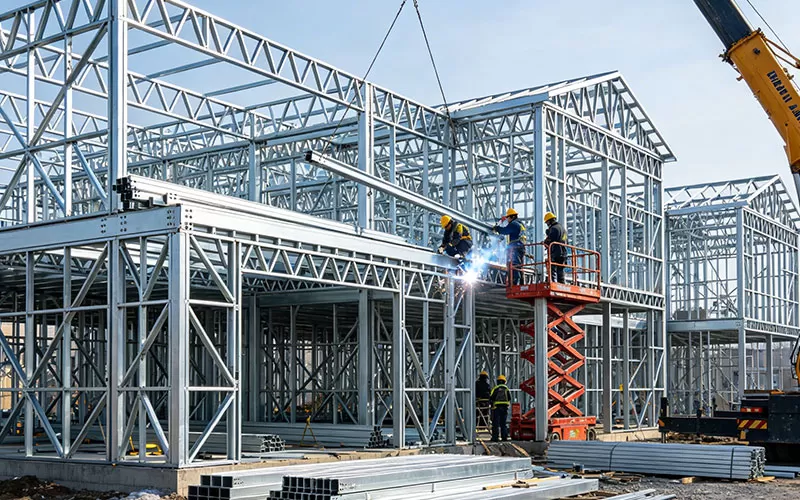
Becoming EPC qualified means proving that a contractor can take integrated responsibility for Engineering, Procurement and Construction, rather than only supplying materials or managing site work. For industrial buildings, warehouses, factories and steel structure projects, EPC qualification requires technical design coordination, supply chain control, fabrication capability, construction management, safety systems, QA/QC documentation and project delivery experience.
Megasteel provides EPC contractor services, steel structure fabrication and pre-engineered metal building solutions for industrial steel buildings, helping owners coordinate design, procurement, manufacturing and construction under one project workflow.
EPC qualified means a contractor has the technical, commercial and operational capability to deliver a project from engineering design coordination through procurement, construction, testing and handover. In practice, it is a qualification status based on proven systems, project references, people, procedures and financial reliability.
In EPC delivery, the contractor is expected to manage multiple interfaces and carry higher responsibility than a simple construction subcontractor. The FIDIC EPC/Turnkey contract framework is commonly referenced for projects where the contractor carries broad responsibility for design and construction delivery.
For steel structure projects, EPC qualification usually includes structural design review ability, procurement planning, steel fabrication capacity, coating and delivery control, site erection management, safety planning and final documentation.

Core EPC capability means the contractor can control design, procurement, construction and handover as one connected system. A contractor cannot become EPC qualified by only having a construction team or a fabrication workshop.
The first requirement is engineering capability. The EPC contractor should be able to review drawings, coordinate design interfaces, identify constructability issues and manage technical changes. The second requirement is procurement capability, including supplier qualification, material tracking, delivery planning and cost control.
The third requirement is construction management. This includes schedule planning, subcontractor coordination, site safety, quality inspection and handover management. The AIA project delivery primer explains that integrated delivery methods differ from traditional design-bid-build because design and construction responsibilities are organized differently, which is why EPC contractors need stronger coordination ability.
Megasteel was established in 2007 and has completed 600+ projects covering more than 20 million m² of steel buildings, which gives buyers a practical reference for evaluating EPC project experience.
Building EPC qualification means developing systems that can be audited, repeated and proven through real projects. It is not only a license issue; it is a capability-building process.
A contractor should first build a technical team covering structural engineering, procurement, fabrication, construction, cost control and project management. Next, it should establish standard procedures for design review, supplier selection, shop drawing control, material inspection, production tracking, site installation and change management.
The contractor should then collect project evidence, including similar project references, completion records, safety performance, inspection reports, client acceptance documents and delivery photos. The DBIA best practices approach is useful because it emphasizes early team alignment, qualifications and collaboration in integrated delivery environments.
For steel building EPC, fabrication capability is especially important. Megasteel’s intelligent assembly base covers 162,000 m², including 116,000 m² of built-up area, with annual production capacity of about 250,000 tons, supporting large-scale steel structure project delivery.
An EPC qualification checklist is a structured review used by owners to verify whether a contractor can safely and reliably deliver an integrated project. It helps separate a true EPC contractor from a supplier that only handles one part of the work.
| Qualification Area | What Owners Should Check | Why It Matters |
|---|---|---|
| Engineering Capability | Design review, shop drawing coordination, constructability input | Reduces design-to-site conflicts |
| Procurement System | Supplier qualification, material tracking, delivery planning | Controls cost, quality and schedule |
| Fabrication Capacity | Workshop size, equipment, welding control, coating process | Ensures steel members fit and arrive on time |
| Construction Management | Erection plan, site team, schedule control, safety system | Reduces site delay and rework |
| QA/QC Documentation | Inspection records, test reports, traceability documents | Supports acceptance and audit requirements |
| Safety Performance | Method statements, lifting plans, training records | Protects workers and project continuity |
| Financial Strength | Cash flow, insurance, bonding ability where required | Reduces contract execution risk |
| Project References | Similar completed projects by scale and building type | Proves practical delivery experience |
For international or lender-reviewed projects, owners may also request certifications, factory audit records, environmental and safety documents, performance bonds, warranty terms and operation or maintenance manuals.
Owners evaluate EPC-qualified contractors by checking whether the company can reduce interface risk, not just whether it can offer the lowest price. The best EPC contractor should provide technical confidence, transparent documentation and predictable execution.
A qualified EPC contractor should be able to explain how engineering decisions affect procurement, how procurement affects fabrication, and how fabrication affects site installation. It should also show a clear communication process for design changes, RFIs, material approval, inspection points, schedule updates and project handover.
For industrial steel buildings, Megasteel connects EPC delivery with steel structure fabrication, PEMB systems, curtain wall coordination and construction management. This integrated model helps owners manage factories, warehouses, logistics centers and commercial steel buildings with fewer coordination gaps between suppliers and site teams.
Becoming EPC qualified requires more than experience in construction. A contractor must prove integrated capability across engineering, procurement, fabrication, construction, quality control, safety and project handover. For steel structure projects, factory capacity, technical coordination and installation planning are especially important because errors in one stage can create cost and delay in another.
Megasteel supports EPC-qualified delivery through design coordination, steel structure fabrication, pre-engineered building systems and construction management. For owners selecting an EPC partner, the safest approach is to evaluate project references, technical team strength, procurement systems, fabrication capacity, QA/QC documentation and site management before making a final decision.
EPC qualified means a contractor can manage Engineering, Procurement and Construction under one integrated project responsibility, supported by technical capability, systems and project experience.
An EPC contractor needs engineering coordination, procurement control, construction management, QA/QC systems, safety procedures, financial reliability and similar completed project references.
No. Licenses may be required depending on the country or project, but EPC qualification also depends on real capability, documentation, management systems and delivery experience.
Fabrication capacity affects steel member accuracy, delivery schedule, coating quality and installation efficiency, making it critical for steel structure EPC projects.
Owners usually review company profile, project references, technical team, supplier control, fabrication workshop, QA/QC records, safety documents, financial strength and construction plan.
Megasteel provides EPC contractor services, steel structure fabrication, pre-engineered metal building systems and construction coordination for industrial and logistics projects, helping owners manage design, procurement, fabrication and installation more efficiently.

Email:
sales@megasteelsh.comAddress:
9/F, Building 8, No.2377 Shenkun Road, Minhang District, Shanghai, CN
 EN
EN
 jp
jp  ko
ko  fr
fr  de
de  es
es  it
it  pt
pt  ar
ar  vi
vi  tr
tr