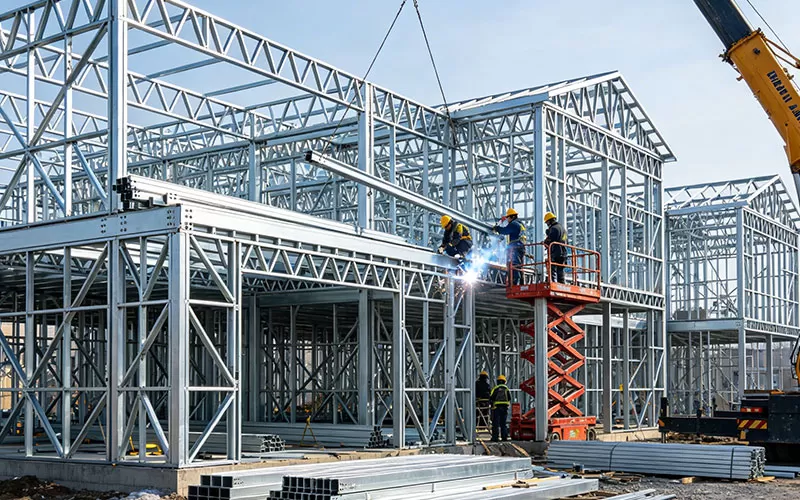
A steel structure in civil engineering is a load-bearing framework made primarily from structural steel members—such as beams, columns, trusses, and frames—designed to safely resist and transfer loads like gravity, wind, and seismic forces. It replaces or complements traditional materials such as reinforced concrete or masonry, offering higher strength-to-weight ratios, faster construction, and greater flexibility in architectural form.
In civil engineering, steel structures are engineered systems where steel is the principal material used to form the structural skeleton of buildings, bridges, industrial plants, and other infrastructure. These systems include primary members (columns, beams, girders, trusses) and secondary members (purlins, girts, bracing) that work together to carry dead loads, live loads, wind, and earthquake actions down to the foundations. Because structural steel is strong yet relatively light, it enables long spans and large open spaces—such as the wide interiors seen in industrial halls and commercial complexes—without excessive member sizes.
Steel structures offer several major advantages. They are highly durable and can perform well in severe climates when protected against corrosion and fire, which lowers long-term maintenance demands compared with many traditional materials. Their high strength-to-weight ratio allows slimmer members and reduced foundation sizes, often translating into shorter construction times and lower labor costs through prefabrication and rapid on-site assembly. Steel is also recyclable, so using it supports modern sustainability and circular-economy goals, especially when combined with energy-efficient building systems and renewable technologies like building-integrated photovoltaics.
Steel structures are widely used in commercial buildings, high-rise office towers, airports, stadiums, bridges, factories, logistics centers, and large-span roofs. In industrial and logistics projects, steel frames and pre-engineered metal buildings are favored because they can carry heavy loads while maintaining unobstructed floor areas for machinery, storage, and material handling. Steel is also central to many green and high-performance buildings, where efficient envelopes and advanced cladding systems are combined with steel frames to meet demanding functional, architectural, and sustainability targets.
Designing a steel structure requires careful assessment of loads (dead, live, wind, seismic, temperature effects), selection of appropriate steel grades and section profiles, and compliance with relevant design codes. Engineers must check strength, stiffness, stability (including buckling), and serviceability (deflections, vibrations). Connection design—bolted or welded—is critical to the overall behavior of the frame. Modern practice relies heavily on 3D modeling, structural analysis software, and BIM to coordinate structural steel with cladding, services, and architecture. Experienced steel contractors such as Megasteel leverage prefabrication and high-precision fabrication to ensure that members fit together smoothly on site, reducing errors and rework.
Steel structures also present challenges, including susceptibility to corrosion, fire protection requirements, and exposure to fluctuations in steel prices. Corrosion is mitigated through protective coatings, galvanizing, and the use of appropriate details that avoid water traps. Fire resistance is addressed by applying fireproofing materials, using fire-resistant cladding, or encasing steel where needed to meet building regulations. Cost and schedule risks are managed through early design coordination, optimized member selection, and efficient supply chains. Companies like Megasteel address these issues with advanced coatings, standardized detailing, and robust project management, enabling steel structures to remain reliable, economical, and sustainable components of modern civil engineering.

Email:
sales@megasteelsh.comAddress:
9/F, Building 8, No.2377 Shenkun Road, Minhang District, Shanghai, CN
 EN
EN
 jp
jp  ko
ko  fr
fr  de
de  es
es  it
it  pt
pt  ar
ar  vi
vi  tr
tr