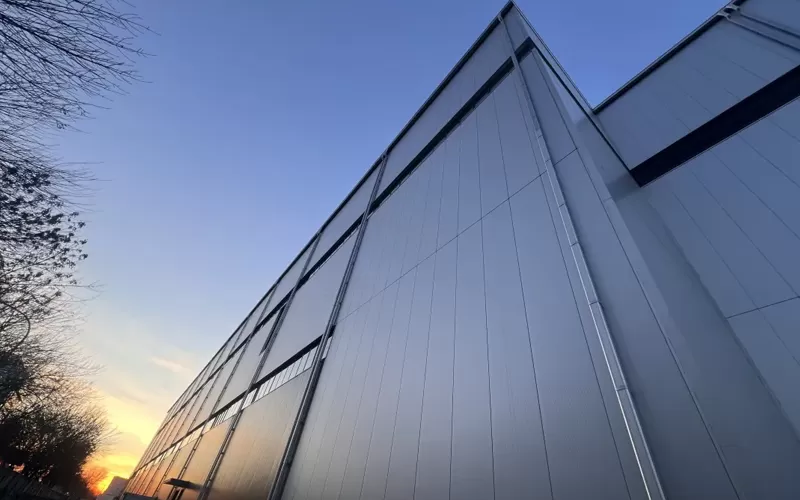
The building integrated photovoltaics market refers to the global demand for photovoltaic systems that are integrated into building envelopes such as roofs, façades, skylights, canopies and cladding. Unlike conventional rooftop solar panels, BIPV products serve both as construction materials and power-generating systems.
For industrial buildings, warehouses and logistics parks, BIPV is becoming more attractive because large roof and façade areas can be turned into productive energy assets. Megasteel provides Mega-BIPV Building Integrated Photovoltaics for industrial and logistics facilities where steel structure, roof systems and distributed solar generation need to be planned together.
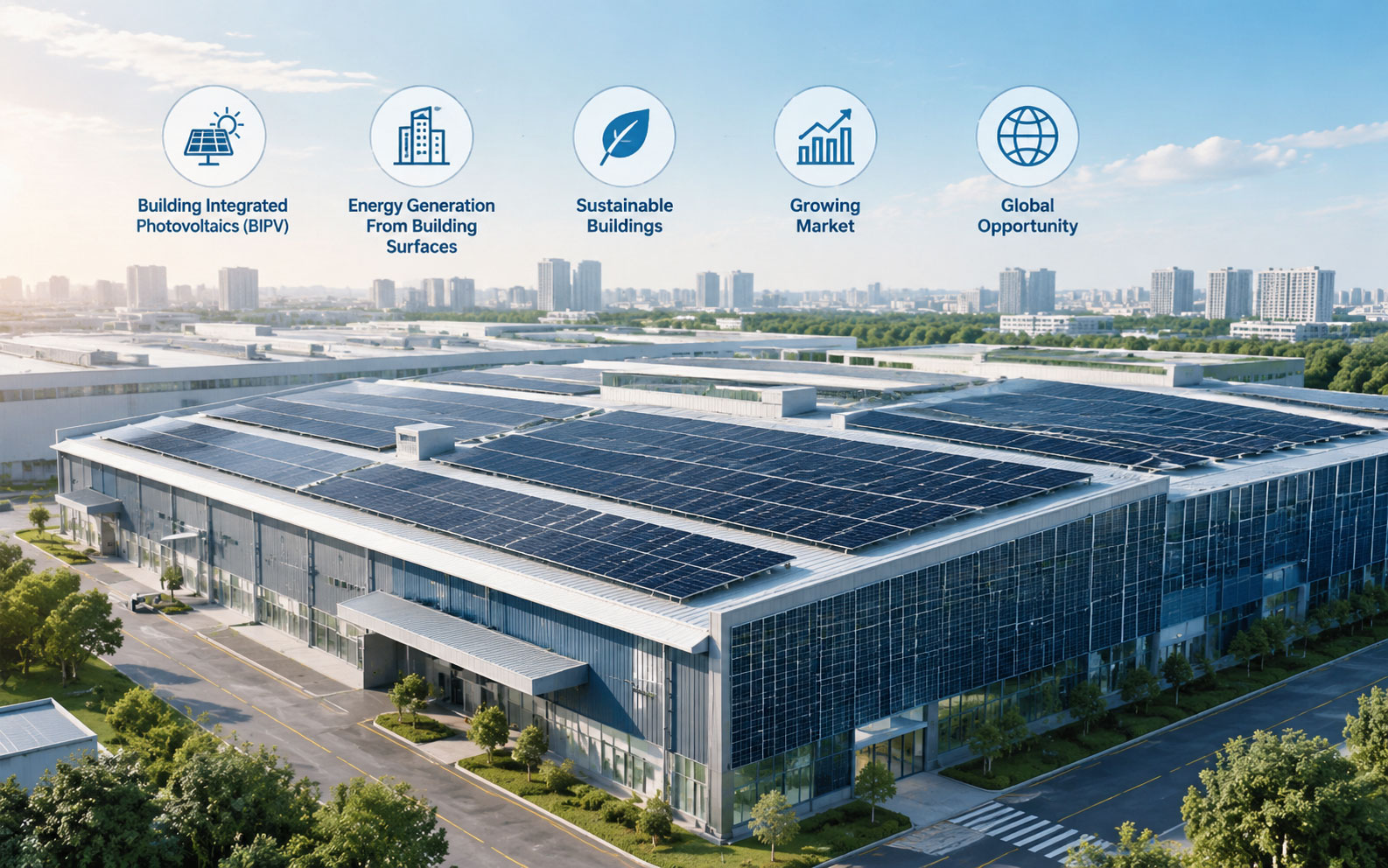
The building integrated photovoltaics market is driven by renewable energy demand, green building policies, falling solar costs and the need to use building surfaces more efficiently. As factories and logistics facilities consume large amounts of electricity, owners are increasingly looking at roofs and façades as energy-generating assets.
Grand View Research estimates that the global BIPV market was USD 23.67 billion in 2023 and may reach USD 89.8 billion by 2030, growing at a 21.2% CAGR from 2024 to 2030. Buyers can review the building-integrated photovoltaics market report for market segmentation by technology, application, end use and region.
The broader solar market also supports BIPV growth. The International Energy Agency reported that renewable capacity additions grew by about 50% in 2023, reaching nearly 510 GW, with solar PV accounting for around three-quarters of additions. The IEA’s Renewables 2023 market report helps explain why building-based solar is becoming part of global energy planning.
BIPV market segments are usually divided by application, including roof-integrated PV, façade-integrated PV, glass PV, wall systems and other building envelope components. For industrial projects, roof-integrated BIPV is often the most practical starting point because warehouses and factories usually have large roof areas.
| BIPV Segment | Main Application | Market Opportunity | Buyer Consideration |
| BIPV Roof | Warehouses, factories, logistics parks | Large area and easier integration | Roof load, waterproofing, drainage, maintenance |
| BIPV Façade | Offices, industrial parks, public buildings | Strong design value and vertical surface use | Shading, orientation, façade structure |
| BIPV Glass | Skylights, curtain walls, canopies | Daylighting and power generation | Transparency, heat gain, safety glass |
| BIPV Wall / Cladding | Industrial and commercial exteriors | Envelope replacement and energy generation | Fire rating, weatherproofing, wind load |
| Hybrid Steel + BIPV System | Industrial buildings and logistics facilities | Integrated structure, enclosure and PV design | Structural coordination and EPC capability |
The BIPV façade segment is also growing quickly. Grand View Research estimated the global BIPV façade market at USD 2.8 billion in 2023, with a projection to USD 18.3 billion by 2030 and a 31.4% CAGR. This shows that façades are no longer only architectural surfaces; they are becoming part of distributed energy design.
Megasteel’s Pre-Engineered Metal Building solutions can support BIPV projects because roof panels, wall systems, steel frames and photovoltaic integration need to be coordinated from the early design stage.
The BIPV market opportunity comes from combining building envelope investment with renewable power generation, but the challenge is that BIPV must satisfy both construction and electrical performance requirements. A successful project is not only a solar project; it is also a roof, façade, waterproofing and structural engineering project.
For industrial owners, BIPV can reduce grid electricity dependence, improve ESG performance, support green factory certification and increase the productive value of roofs. For developers, BIPV may improve the long-term attractiveness of industrial parks and logistics assets. NREL’s Building-Integrated Photovoltaic report explains that BIPV systems can produce electricity while also forming part of roof or wall systems.
However, buyers must manage waterproofing, structural load, wind uplift, fire safety, maintenance access, inverter layout, grid connection and long-term module replacement. This is why BIPV projects often require coordination between architects, structural engineers, PV designers, steel fabricators and EPC contractors.
Megasteel’s EPC Contractor service is valuable for BIPV industrial projects because engineering, procurement, construction, steel structure, building envelope and PV integration can be managed under a more coordinated delivery process.
BIPV supplier evaluation should focus on engineering integration, structural reliability, waterproofing design, PV performance, project experience and lifecycle service. Choosing a supplier only by module price can create risks if the roof system, steel frame and electrical system are not designed together.
Industrial buyers should ask whether the supplier can coordinate steel structure design, roof panel integration, load-bearing checks, drainage, fire protection, module layout, inverter placement, construction sequencing and future maintenance. For large-scale warehouses, the structural and envelope system must be considered before module installation.
Megasteel’s Steel Structure Fabrication capability supports BIPV projects because steel framing quality affects roof stability, installation precision and long-term building performance. Megasteel’s Mega-BIPV cases include industrial and logistics projects such as GLP Anhui Intelligent Storage Project with 76,323㎡ and Suzhou Adidas Project with 40,000㎡, showing its experience in large building-integrated photovoltaic applications.
The building integrated photovoltaics market is growing because buildings are increasingly expected to generate clean energy while still performing as durable, safe and efficient structures. Roofs, façades, glass systems and cladding are becoming energy-generating building components rather than passive surfaces.
For industrial buyers, BIPV is especially relevant because factories, warehouses and logistics buildings offer large usable roof and façade areas. Megasteel supports the BIPV market with Mega-BIPV systems, pre-engineered metal buildings, steel structure fabrication and EPC contractor services, helping owners combine structural performance, building enclosure quality and renewable power generation in one integrated project approach.
The building integrated photovoltaics market refers to BIPV products and systems used in roofs, façades, glass, walls and cladding to generate electricity while serving as building materials.
Grand View Research estimates the global BIPV market may grow from USD 23.67 billion in 2023 to USD 89.8 billion by 2030, at a 21.2% CAGR.
Roof-integrated BIPV is common in industrial and logistics buildings because large roof areas can support solar generation with relatively practical installation planning.
BIPV helps industrial buildings generate on-site electricity, reduce energy dependence, support sustainability goals and improve the functional value of roofs and façades.
Buyers should check roof load, waterproofing, wind resistance, fire safety, PV layout, electrical design, maintenance access, grid connection and supplier engineering capability.
Megasteel provides Mega-BIPV systems, pre-engineered metal buildings, steel structure fabrication and EPC contractor services for industrial and logistics facilities requiring integrated structure, enclosure and photovoltaic design.

Email:
sales@megasteelsh.comAddress:
9/F, Building 8, No.2377 Shenkun Road, Minhang District, Shanghai, CN
 EN
EN
 jp
jp  ko
ko  fr
fr  de
de  es
es  it
it  pt
pt  ar
ar  vi
vi  tr
tr