Choosing an EPC contracting company means selecting one project partner to manage Engineering, Procurement and Construction under an integrated delivery responsibility. For industrial buildings, warehouses, logistics parks and steel structure projects, the right EPC contractor can reduce interface risks, improve schedule control and connect design, fabrication, procurement and site construction more efficiently.
Megasteel provides EPC Contractor services for industrial steel structure buildings, helping owners coordinate engineering, procurement planning, steel fabrication, building envelope work, quality control, safety management and completion documentation. Megasteel was established in 2007 and has completed more than 600 projects and 20 million+ square meters of steel buildings.
An EPC contracting company is a project delivery company responsible for engineering design coordination, procurement management and construction execution under one integrated scope. The key advantage is single-point accountability, especially when the owner wants fewer coordination gaps between designers, suppliers, fabricators and site teams.
In an EPC model, the contractor may manage technical design review, material sourcing, supplier selection, steel fabrication, logistics, construction planning, subcontractor coordination, installation quality, safety control and handover documents. FIDIC explains that its EPC/Turnkey Contract is used where the employer wants the contractor to take broad responsibility for design and construction, with greater certainty over price and time.
For industrial steel buildings, EPC capability is especially important because structure, roof, wall, fire protection, cranes, drainage, loading docks and future expansion must be coordinated early.
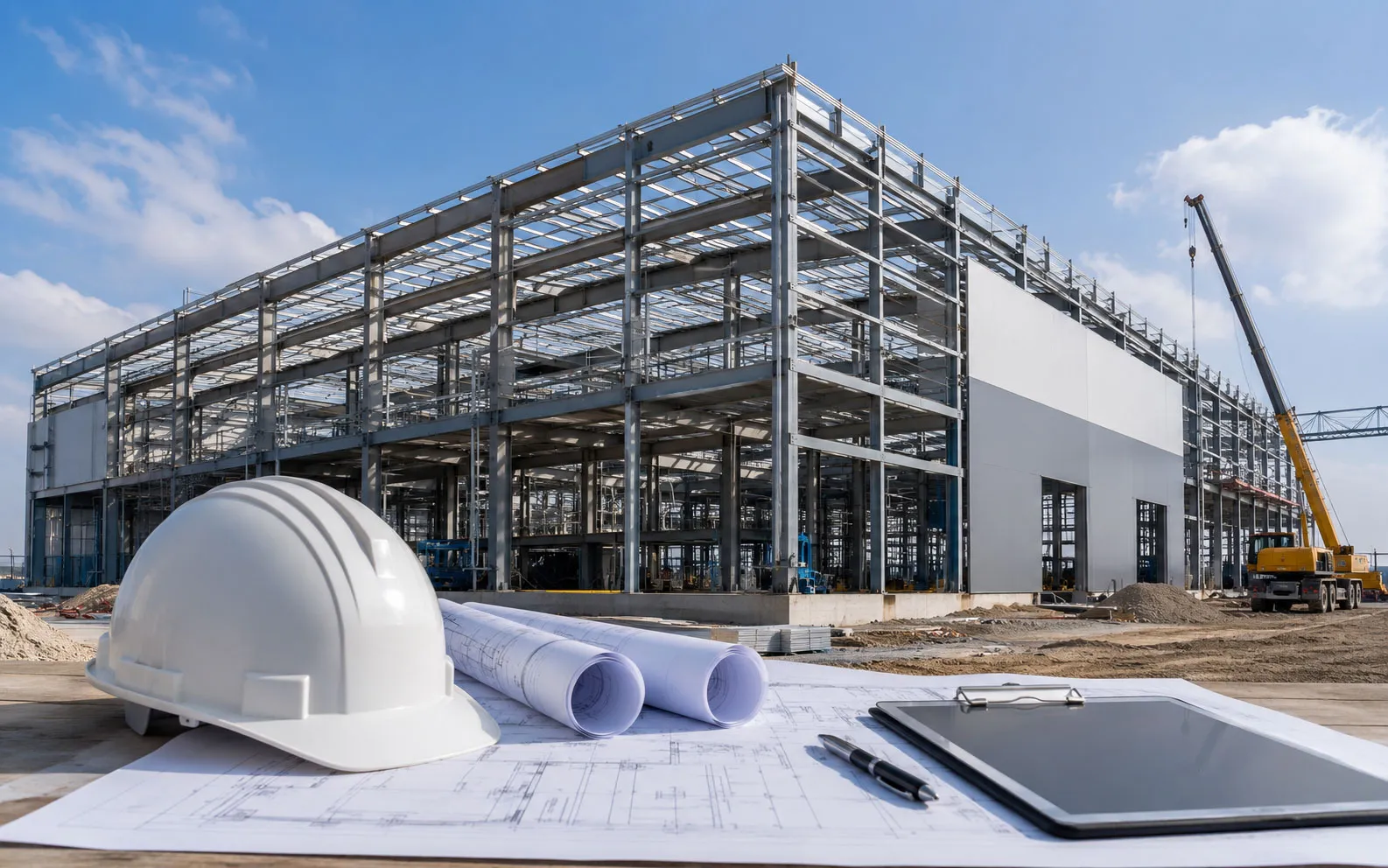
Evaluating an EPC contracting company means checking whether it has the engineering ability, procurement control, construction management and project experience to deliver the full scope. A strong EPC contractor should prove capability before price negotiation, not after contract signing.
The first checkpoint is project experience. Ask whether the company has completed similar factories, warehouses, logistics centers or industrial parks in size, span, load, climate and delivery model. The second checkpoint is engineering coordination: the company should understand structural systems, local codes, wind and snow loads, foundation interfaces, roof drainage, wall cladding and equipment requirements. The third checkpoint is manufacturing and supply chain control.
Megasteel’s Steel Structure Fabrication capability supports EPC projects because factory fabrication quality affects bolt fit-up, installation speed, coating quality and site rework risk. Megasteel’s intelligent assembly base covers 162,000 square meters, with 116,000 square meters of built-up area and annual output of 250,000 tons, which is relevant for buyers evaluating delivery capacity.
An EPC contracting company should be compared by real delivery capability, not only by quotation price. The table below gives buyers a practical evaluation framework.
| Evaluation Item | Strong EPC Company | Risky EPC Company |
| Engineering Capability | Provides design coordination, technical review and constructability input | Only quotes after drawings, with weak technical support |
| Procurement Control | Has supplier qualification, material tracking and delivery planning | Depends on unstable suppliers or unclear purchasing process |
| Fabrication Capacity | Own or closely managed fabrication system with QC records | Limited control over steel member production |
| Construction Management | Clear schedule, safety system and installation plan | Vague site organization and unclear responsibilities |
| Quality Control | Inspection points, testing records and handover documentation | Relies on final inspection only |
| Contract Clarity | Defines scope, exclusions, timeline, payment and risk allocation | Uses unclear scope and many hidden variation risks |
| Project Experience | Similar completed projects and verifiable cases | No comparable industrial building references |
| After-Sales Support | Provides warranty, maintenance guidance and issue response | Disappears after project completion |
For comparison with other delivery methods, the AIA project delivery terms primer explains design-bid-build, construction management at risk and design-build. DBIA also states that design-build uses a single contract between owner and design-builder, which helps explain why integrated delivery models reduce owner-side coordination complexity.
Contract and delivery checks are the final review steps used to confirm whether the EPC contractor can deliver the project safely, legally, on schedule and within the agreed scope. This stage protects the owner from unclear responsibility, hidden cost and delayed handover.
Before signing, buyers should confirm the employer’s requirements, technical specifications, milestone schedule, payment terms, variation procedure, quality standards, safety plan, liquidated damages, warranty scope and acceptance criteria. The EPC contractor should also provide a procurement plan, fabrication schedule, construction method statement and project communication mechanism.
DBIA’s Design-Build Best Practices are useful because they emphasize early team alignment, owner readiness and collaborative delivery principles. For industrial projects, buyers should also verify whether the contractor can connect EPC delivery with Pre-Engineered Metal Building systems, curtain wall, cladding, roofing and steel structure interfaces.
Megasteel supports EPC delivery for factories, warehouses and logistics projects through EPC contracting, pre-engineered metal buildings, steel structure fabrication and enclosure coordination. This makes it suitable for buyers who want one partner to manage structure, procurement, construction planning and building envelope integration.
Choosing an EPC contracting company is the process of selecting a contractor with proven engineering, procurement, fabrication, construction and risk-control capability. The best EPC partner should offer more than a low price; it should provide technical confidence, schedule discipline, quality control and transparent contract management.
For industrial steel structure buildings, Megasteel provides EPC contractor services, PEMB solutions and steel fabrication support to help owners reduce coordination risk and improve project delivery. Buyers should compare EPC companies by experience, technical depth, fabrication capacity, supplier control, site management, safety system and handover documentation before making the final decision.
Check whether the EPC contractor has completed similar projects in building type, size, span, load requirement, climate and delivery scope.
Not usually. A low quotation can hide unclear scope, weak procurement control, poor site management or future variation costs.
A qualified EPC contractor should provide technical proposals, project schedule, procurement plan, quality control process, safety plan, construction method statement and handover documentation.
Fabrication capacity affects steel member accuracy, surface treatment, delivery speed, installation quality and the risk of site rework.
A general contractor often focuses on construction execution, while an EPC contractor may manage engineering, procurement and construction under one integrated responsibility.
Megasteel provides EPC contracting, pre-engineered metal buildings and steel structure fabrication for industrial and logistics projects, helping buyers coordinate design, procurement, manufacturing and construction delivery.

Email:
sales@megasteelsh.comAddress:
9/F, Building 8, No.2377 Shenkun Road, Minhang District, Shanghai, CN
 EN
EN
 jp
jp  ko
ko  fr
fr  de
de  es
es  it
it  pt
pt  ar
ar  vi
vi  tr
tr