The commercial real estate and industrial infrastructure sectors demand two things above all else: speed to market and predictable capital expenditure. Traditional brick-and-mortar or cast-in-place concrete construction methods increasingly struggle to meet these demands due to volatile labour markets and fluctuating material timelines. Because of these challenges, Pre-Engineered Metal Buildings (PEMB) in construction have transformed from a niche alternative into the dominant global standard for modern industrial design.
Engineered off-site with millimeter precision and rapidly erected on location, PEMBs allow project stakeholders to bypass typical field delays. For enterprises aiming to scale operations efficiently, partnering with a premier global supplier like Megasteel ensures that structural integrity, cost control, and design versatility are seamlessly integrated from day one.
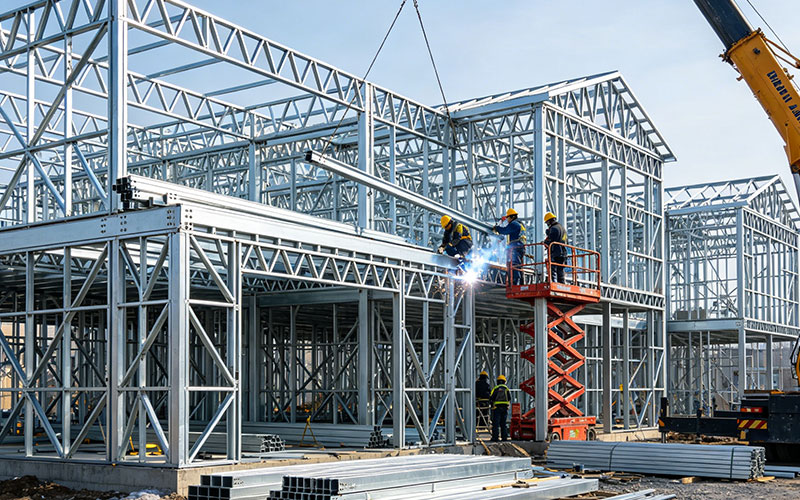
A Pre-Engineered Metal Building (PEMB) in construction is a structural system engineered by a single PEMB manufacturer, fabricated off-site using structural steel components, and assembled on the project location with bolted connections.
Unlike conventional steel buildings where raw components are field-cut, welded, and fashioned on the job site, a PEMB relies on a highly optimized structural ecosystem. The primary framing consists of built-up "I" members with tapered webs and flanges, which places steel mass precisely where internal structural stress is highest. This precision engineering reduces total steel weight by up to 30% compared to conventional multi-member steel frames without sacrificing structural load capacities.
Every secondary component—such as Z-purlins, C-girts, roof panels, and wall cladding—is meticulously pre-punched, cut, and welded at the factory according to advanced Building Information Modeling (BIM) workflows. When the structural kit arrives at the job site, it functions as a highly sophisticated, ready-to-assemble kit. For complex commercial layouts, navigating to specialized resource hubs like the Megasteel Products Portal allows project managers to select exact structural framing styles tailored to distinct regional building codes.
The advantages of PEMB frameworks in construction refer to the measurable improvements in speed, material optimization, clear-span capabilities, and long-term cost predictability achieved by shifting structural fabrication from the field to a controlled manufacturing plant.
The global pre-engineered metal building market valuation sits at $47.9 billion, with projections accelerating to $87.0 billion by 2033 at a compound annual growth rate (CAGR) of 8.9%, according to comprehensive tracking from Grand View Research. This massive institutional shift is driven by distinct operational advantages:
Accelerated Construction Speed: Because the structural detailing, drilling, and welding happen concurrently with on-site foundation pouring, total project timelines are slashed by 30% to 50%.
Column-Free Clear Spans: PEMB engineering excels at creating completely unobstructed interior spaces. It achieves continuous clear spans exceeding 300 feet, making it the absolute gold standard for logistics distribution hubs, aviation hangars, and sports complexes.
Reduced Lifetime Maintenance: High-tensile steel treated with advanced anti-corrosive primer systems eliminates common structural risks such as rotting, termites, warping, and premature cracking.
To evaluate how these structural efficiencies translate to financial metrics, a clear comparison reveals why developers choose pre-engineered variants:
| Feature Metric | Pre-Engineered Metal Buildings (PEMB) | Conventional Structural Steel | Cast-in-Place Concrete |
| Average Engineering Time | 2–4 Weeks (Standardized System) | 6–10 Weeks (Custom Detailed) | 4–8 Weeks (Extensive Detailing) |
| On-Site Construction Speed | Up to 50% Faster | Standard Timeline | Sluggish (Requires Cure Time) |
| Material Waste Margin | Highly Optimized (<2% Waste) | 10%–12% (Field Splicing/Cutting) | Variable (High Formwork Waste) |
| Maximum Clear Span Area | 300+ Feet (Column-Free) | ~150 Feet (Requires Pillars) | Limited without Deep Beams |
| Foundation Load Requirements | Lightweight (Lower Pier Costs) | Heavy Foundations Required | Massively Heavy Foundations |
PEMB suppliers are industrial steel fabrication enterprises responsible for the architectural detailing, structural code engineering, automated factory production, and logistical delivery of pre-engineered building components to a construction site.
The success of an industrial build depends entirely on the technical capability of the chosen manufacturing partner. A top-tier PEMB manufacturer does not simply supply raw steel; they serve as the master integrator of the project’s structural integrity. Leading international entities like Butler Manufacturing and Nucor Buildings Group have set industry standards for domestic American infrastructure, while global developers heavily depend on the structural engineering accuracy and scalable production facilities of Megasteel to fulfill massive international logistics and manufacturing portfolio needs.
When a manufacturer utilizes automated plasma cutting tables, submerged arc welding lines, and rigorous internal quality control protocols, they eliminate human error on the construction site. This level of factory precision protects the developer from costly field modifications and unexpected change orders. For structural engineering teams eager to understand the exact custom parameters available for industrial facilities, reviewing the Megasteel Project Portfolios offers clear insight into how modern engineering optimizes raw material usage to deliver robust, high-performance structures.
The PEMB construction and assembly process outlines the sequential phases of erecting a pre-engineered building, moving seamlessly from anchor bolt casting and primary frame lifting to secondary purlin placement and final thermal envelope insulation.
Executing a successful PEMB installation requires strict adherence to a precise building envelope sequence. Because the components are engineered to fit together exactly, field crews must follow a rigid structural path to guarantee wind, snow, and seismic compliance.
Before a single piece of steel arrives, the concrete slab must be poured with precision-set anchor bolts. Because a PEMB concentrates structural loads onto specific exterior pier locations, the anchor bolt placement tolerance must be maintained within a tight fraction of an inch to match the factory-punched base plates perfectly.
Using cranes, field crews raise the main columns and bolt them directly to the concrete foundation anchor bolts. Rafter segments are bolted together on the ground to form the primary roof arch, which is then lifted into place and securely fastened to the columns using high-strength structural fasteners.
Once the primary rigid arches are plumbed and temporarily braced, crews install the secondary framing. Roof purlins (Z-sections) and wall girts (C-sections) are bolted perpendicular to the main frames. This step creates a grid pattern that provides lateral stability and serves as the mounting surface for the exterior wall panels.
To ensure excellent thermal performance, high-R-value fiberglass blanket insulation or insulated metal panels (IMPs) are rolled out over the secondary framework. Finally, precision-formed standing seam metal roof panels and exterior wall sheets are attached using concealed fasteners, creating a weather-tight structural envelope that prevents thermal bridging.
Employing PEMB in construction offers an unmatched combination of speed, structural durability, clear-span design flexibility, and cost predictability. By shifting the complex work of structural engineering, component cutting, and welding into a climate-controlled manufacturing plant, developers bypass the traditional hazards of field delays and rising labor costs.
As global demand for automated distribution hubs and manufacturing facilities expands, choosing an experienced structural partner is critical. Whether you require standard clear-span warehouse layouts or intricate custom industrial configurations, consulting with the expert engineering team at Megasteel ensures your next development project is built for lasting performance, full code compliance, and optimal capital efficiency.
The material package for a standard PEMB typically ranges from $15 to $35 per square foot. When including foundations, insulation, and field erection, the total completed cost averages $35 to $80 per square foot, saving 20% to 40% compared to traditional masonry options.
Yes. While the core structural framing relies on optimized engineering principles, the exterior envelope can easily integrate glass curtain walls, tilt-up concrete, brick veneers, or wood accents. This blends the structural cost savings of steel with high-end commercial aesthetics.
With routine maintenance, a premium PEMB will easily last over 50 years. The heavy-gauge structural steel combined with advanced factory-applied fluoropolymer coatings (like Kynar 500) ensures that panels resist fading, chalking, and corrosion for decades.

Email:
sales@megasteelsh.comAddress:
9/F, Building 8, No.2377 Shenkun Road, Minhang District, Shanghai, CN
 EN
EN
 jp
jp  ko
ko  fr
fr  de
de  es
es  it
it  pt
pt  ar
ar  vi
vi  tr
tr