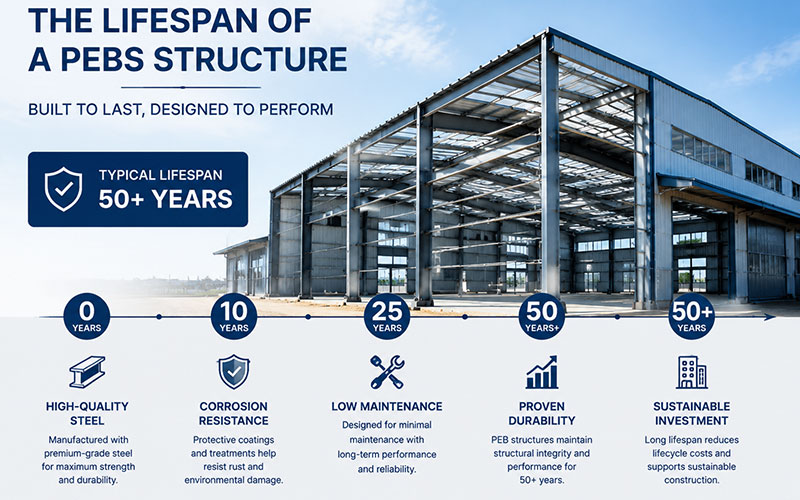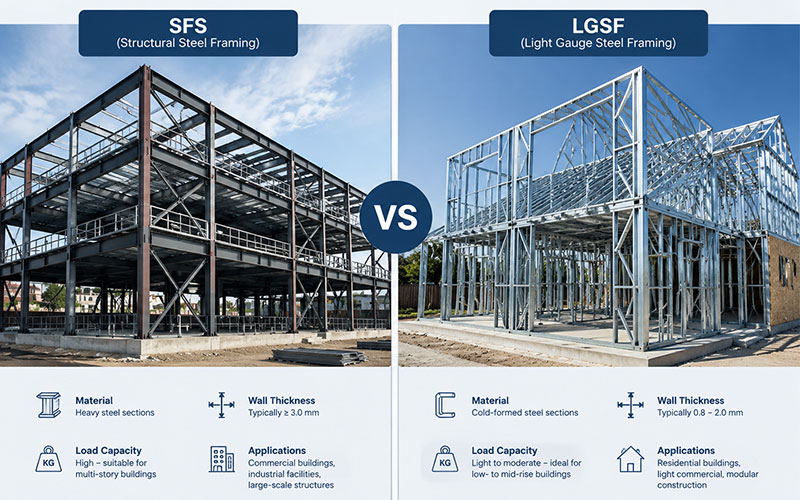
A structural steel framework is essentially the load-bearing skeleton of a building, made up of interconnected steel members that work together to support and stabilize the entire structure. It uses steel's high strength-to-weight ratio to create tall, wide, and efficient buildings with relatively lightweight components.
A structural steel framework consists of steel columns, beams, and girders arranged to form the core support system of a structure. These elements create a three-dimensional frame that carries vertical loads from floors and roofs, as well as horizontal forces from wind and earthquakes, safely down to the foundations. Steel frameworks became prominent in the late 19th century, enabling landmark structures such as early skyscrapers and large-span bridges, and they remain central to contemporary high-rise and industrial construction. Today, structural steel is widely used in commercial buildings because it allows long spans, flexible floor plans, and rapid construction.
The main components of a structural steel framework are columns, beams, and bracing members. Columns are vertical members that transfer loads from the beams and slabs above down to the foundations, while beams are horizontal or sloping members that carry floor and roof loads and pass them to the columns. Diagonal bracing or rigid moment connections are often added to resist lateral forces and prevent the frame from swaying under wind or seismic actions. In pre engineered and custom steel buildings, engineers carefully design the sizes, shapes, and connections of these members so the framework can support the intended loads efficiently while using material economically.
Using steel for the building framework offers several advantages in strength, durability, and construction speed. Structural steel has high tensile and compressive strength, which means it can carry large loads with relatively small cross-sections, enabling slender columns and long-span beams. The components are typically prefabricated with high precision and then bolted or welded together on-site, accelerating the construction schedule and reducing labor costs. Steel also performs well in harsh environments when properly protected against corrosion and fire, and it is highly recyclable, making it compatible with modern sustainability targets and green building standards.
Structural steel frameworks are widely used in industrial and logistics buildings because they can accommodate large clear spans and heavy loads, ideal for factories, warehouses, and distribution centers. They are also common in commercial offices, shopping centers, and mixed-use developments that require open floor plates and future adaptability. In many projects, the steel frame is paired with curtain wall systems and other façade solutions to achieve both structural performance and architectural expression, resulting in buildings that are robust, efficient, and visually distinctive.
Steel framework technology continues to evolve through digital design tools, advanced analysis, and automated fabrication. Building Information Modeling (BIM) and sophisticated structural analysis software allow engineers to optimize member sizes, connections, and details, improving safety and material efficiency. Automation and robotics in fabrication and erection are enhancing accuracy and reducing construction time, while integrated smart sensors enable real-time monitoring of structural behavior over the building's life. Coupled with growing emphasis on low-carbon steel production, renewable energy integration, and circular design, these innovations are ensuring that structural steel frameworks remain a key solution for high-performance and sustainable buildings in the future.

Email:
sales@megasteelsh.comAddress:
9/F, Building 8, No.2377 Shenkun Road, Minhang District, Shanghai, CN
 EN
EN
 jp
jp  ko
ko  fr
fr  de
de  es
es  it
it  pt
pt  ar
ar  vi
vi  tr
tr